Pastry packets
Seal the pack on a heat sealer so it stays closed.
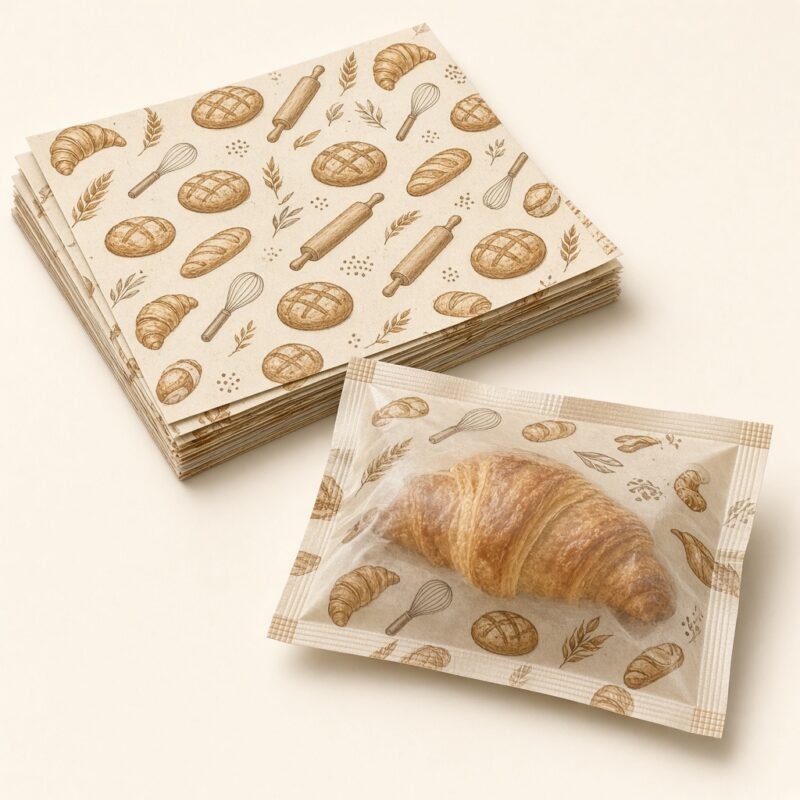
Custom heat-seal papers are wrapping papers that seal with heat — used for pastry packets, portion packs and some bakery wraps. They are not parchment for ovens and not ordinary deli fold-wrap unless we quote a heat-seal coating.
Online purchase for standard sizes will be available soon. Use Custom size to request a quote.
Best for
Heat-sealed pastry packets, portion wraps, bakery packs that must stay closed.
Not ideal for
Open deli folds; oven pan liners; a shopping bag.
How it is used
Heat seal on the coated face. Equipment settings matter — tell us your sealer.
Protection
Coated paper that seals. Food-contact coating on request.
Choose this
Choose heat-seal when the pack must be sealed with a sealer.
Choose the other
Choose wax paper for a fold or twist wrap that is not heat sealed. See that paper
Choose this
Choose heat-seal for packets that close with heat.
Choose the other
Choose parchment for oven liners and baking. See that paper
Consider instead
At a glance
Size
Packet size Match the sealer and the pastry.Material
Heat-seal coated paper Not parchment. Seal face stays clean of heavy ink.MOQ
Quoted by quantity Low minimum. Tiers on your quote.Turnaround
5–7 days After you approve the proof.Shipping
Free in the USA Nothing prints until proof approval.Seal the pack on a heat sealer so it stays closed.
Single servings that must not unfold in a case.
Parchment is the baking liner. Heat-seal is a packet wrap.
Keep heavy ink off the seal area so it bonds.
Outside brand. Proof with the seal zone marked.
Coating and inks that touch food on request.
Custom heat-seal papers are wrapping papers with a coating that seals when you apply heat. Bakeries use them for pastry packets and portion packs that should not pop open in a box. They are not parchment for ovens and not a fold-only deli wrap unless we quote a heat-seal face.
A pastry that has to stay closed through delivery needs a seal, not another fold. Heat-seal paper lets you close a packet on a sealer while still printing the bakery mark on the outside.
Print stays off the seal area so the coating can bond. Tell us the sealer you run — jaw, impulse or continuous — so the coating matches the temperature you already use.
Cut sheets or small rolls for packet lines. We do not treat this as sandwich wrap or as oven liner stock.
Cut to the packet, not to a burger square. Send the finished pack size and how much overlap you need for the seal.
White shows print best on a small packet. Natural sheets are available when the bakery wants a kraft look.
Outside print. Keep ink off the seal face. Proof shows the seal margin so you can check it before press.
Glassine and wax paper remain the fold-wrap options. Parchment is the oven liner. Heat-seal is only for packs that close with heat.
Ask for a food-contact coating and inks. Oily pastry and wet fillings change which coating we quote.
Wrap paper with a coating that seals when you apply heat. Used for pastry packets and portion packs that must stay closed.
No. Parchment is an oven liner. Heat-seal paper is a packet wrap. Do not assume it is baking paper.
A heat sealer matched to the coating. Send the machine or temperature you use so we spec the right face.
Yes. Print sits on the outside. The seal face must stay clear of heavy ink where it seals. We proof that.
Ask for food-contact coating and inks. Tell us if the food is oily or wet.
Send size, quantity, print colors and artwork on this form. We reply with pricing.
You see the logo on the sheet within 24 hours. Nothing prints until you approve.
After written approval we print the run. Typical turnaround is 5–7 business days.
Ships free across the USA. Tracking once the order leaves.
Pay after you approve the proof. No plate fees on the quote.
Reviews
There are no reviews yet.